
Everyday texting refers to the ordinary, informal way people communicate through text messages in their daily lives. It includes casual phrases, abbreviations, emojis, short replies, and conversational language used in regular chats.
Key Takeaways
- Everyday texting means normal, day-to-day communication through text messages.
- It is a descriptive phrase, not a texting abbreviation or acronym.
- Everyday texting can include slang, abbreviations, emojis, shorthand, and casual expressions.
- Context, punctuation, emojis, and the relationship between people can affect how a message sounds.
- The style is usually informal and conversational.
- Language suitable for everyday texting may not always fit professional or formal communication.
Everyday Texting Meaning in Text
In text, everyday texting describes the normal way people communicate through messages during daily conversations.
It can include simple greetings, quick questions, short replies, plans, reactions, jokes, abbreviations, emojis, and casual expressions. For example:
“Hey, what are you doing?”
“Running late lol.”
“Wanna grab food later?”
The phrase everyday texting is not itself a texting abbreviation, acronym, or slang term. Instead, it describes informal online communication and ordinary text-message conversations.
The tone is generally casual and conversational. The exact tone of an individual message can still depend on wording, punctuation, emojis, and context.
What Does Everyday Texting Stand For?
Everyday texting does not stand for anything because it is not an acronym or abbreviation.
It is simply a descriptive phrase combining:
- Everyday — ordinary or occurring as part of daily life
- Texting — communicating through text messages
Together, everyday texting means regular, day-to-day communication through text messages.
How Is Everyday Texting Used?
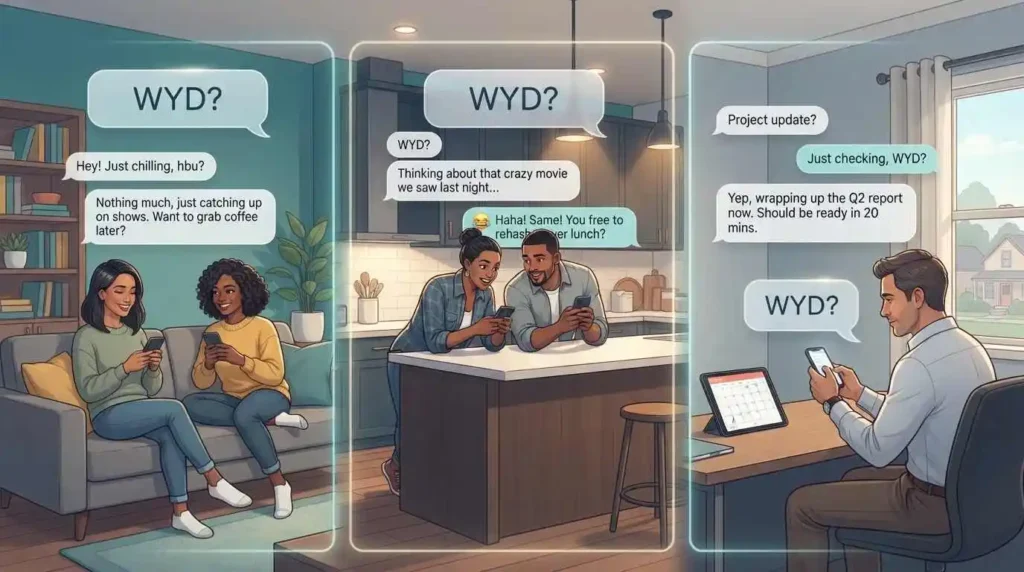
Text Messages
Everyday texting is commonly used for ordinary conversations such as checking in, making plans, asking questions, and sharing updates.
“Are you home yet?”
“Yeah, just got back.”
DMs
The same casual communication style can appear in private messages.
“Hey, did you see my message?”
Group Chats
Group conversations often use short replies and informal language.
“Who’s coming tonight?”
“I am.”
“Same.”
Social Media
Casual messages and reactions can also appear in social media conversations.
“This is actually so funny 😂”
Comments
People may use short, conversational responses in comments.
“No way lol.”
Gaming
Everyday texting can also include quick messages between people discussing games or coordinating activities.
“You playing tonight?”
“Probably around 8.”
Everyday Texting in Different Contexts
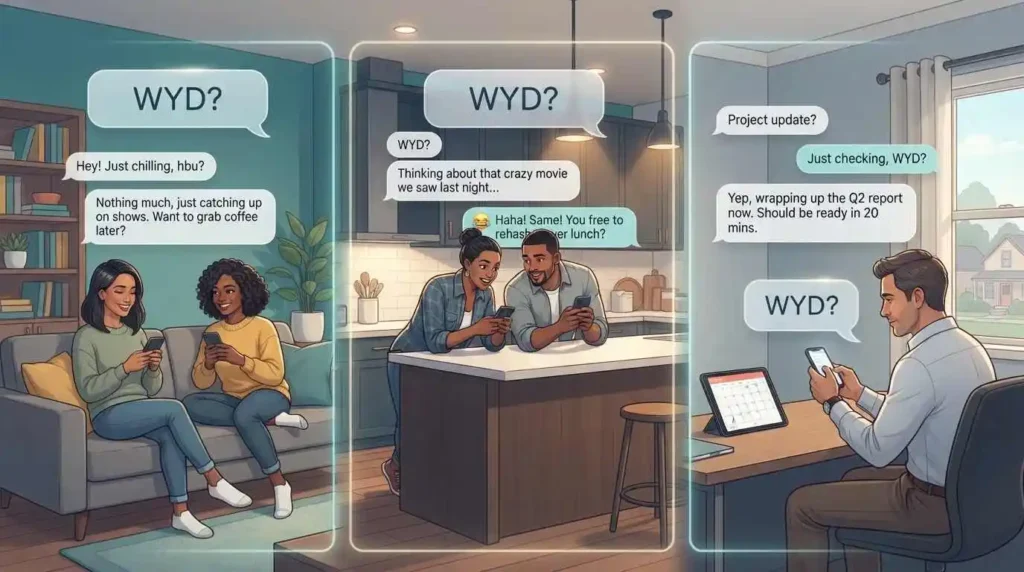
The phrase itself keeps the same basic meaning across different situations, but the style of texting can change depending on the relationship and conversation.
From a Friend
A friend may use very short, relaxed messages:
“You free later?”
This is a normal casual question and does not necessarily carry any deeper meaning.
From a Guy
The meaning of everyday texting does not automatically change because the sender is a guy. The actual wording and surrounding conversation matter more.
From a Girl
The same applies when the sender is a girl. Gender alone does not determine what a casual text means.
From a Crush
If someone you like sends casual messages frequently, the messages should still be interpreted based on the complete conversation rather than assuming romantic intent from texting style alone.
In Dating
Everyday texting can be part of dating conversations, including making plans, checking in, sharing jokes, or continuing a conversation between dates.
In a Relationship
People in relationships may use everyday texting for simple updates and ordinary conversations throughout the day.
In a Group Chat
Messages are often shorter because several people are participating at once.
In Social Media Comments
Casual language may be even shorter because comments are usually quick reactions to posts, photos, or videos.
When interpreting a message, consider the previous messages, wording, punctuation, emojis, relationship, and conversation topic. A casual texting style by itself does not prove flirting, attraction, affection, rejection, anger, or jealousy.
Real Chat Examples
- “Hey, what’s up?”
- “Not much, you?”
- “What are you doing later?”
- “I’m heading home rn.”
- “Wanna get something to eat?”
- “Yeah, sounds good.”
- “Lol I completely forgot.”
- “Are you still coming?”
- “Yep, be there soon.”
- “Can you call me when you’re free?”
- “I’m busy right now, I’ll text you later.”
- “Did you finish that assignment?”
- “Not yet 😭”
- “Okay, no worries.”
- “I’ll let you know.”
- “Wait, what happened?”
- “That’s actually hilarious lol.”
- “I’m so tired today.”
- “Same honestly.”
- “Talk to you tomorrow.”
How to Reply to Everyday Texting
Because everyday texting is a broad communication style rather than one specific expression, the best reply depends on the actual message.
Casual Replies
- “Yeah, same.”
- “Sounds good.”
- “Okay, cool.”
- “I’m down.”
- “Sure.”
Friendly Replies
- “That sounds fun.”
- “Hope you have a good day.”
- “Yeah, I’d love to.”
- “Thanks for letting me know.”
Funny Replies
- “Lol, you’re ridiculous.”
- “Okay, that actually made me laugh.”
- “You really said that 😂”
- “I was not expecting that.”
Neutral Replies
- “Got it.”
- “Okay.”
- “Thanks for letting me know.”
- “I understand.”
Flirty/Relationship Replies
When the conversation is already clearly romantic, the response can match that tone:
- “I was hoping you’d text me.”
- “You always make me smile.”
- “I’d like that.”
- “That sounds like a good plan.”
What Tone Does Everyday Texting Have?
Everyday texting is generally:
- Casual
- Friendly
- Informal
- Conversational
- Direct
- Context-dependent
The style can also become playful, humorous, emotional, or sarcastic depending on the conversation.
For example, “Okay” can sound neutral in one conversation but annoyed or dismissive in another. Punctuation and emojis can also affect how a short message is interpreted.
Is Everyday Texting Rude or Offensive?
Everyday texting is not rude or offensive. It simply describes ordinary informal communication through text.
Casual texting is generally appropriate for friends, family, classmates, social media, and other informal conversations.
However, texting habits such as heavy slang, excessive abbreviations, or very short replies may not be appropriate for every professional or formal situation. In work, school assignments, formal writing, or other professional communication, clearer and more conventional language may be preferable.
Other Meanings of Everyday Texting
Everyday texting does not have a separate acronym meaning in technology, gaming, business, finance, medical terminology, or sports.
It is a general phrase describing ordinary text-message communication.
Individual words or abbreviations used during everyday texting can have their own meanings, but those meanings should be interpreted separately from the phrase everyday texting.
Common Mistakes About Everyday Texting
Assuming Every Short Message Has Hidden Meaning
A short message is not automatically angry, cold, or uninterested. Some people simply prefer brief messages.
Confusing Everyday Texting With Texting Slang
Everyday texting can contain slang, but the two terms are not identical. Texting slang is only one part of everyday text communication.
Assuming Romantic Intent
Frequent or casual texting does not automatically mean someone is romantically interested. The broader relationship and conversation provide more context.
Ignoring Context
A message should not always be interpreted by looking at one word alone. Previous messages and the overall conversation can change its meaning.
Treating Informal Texting as Formal Writing
Everyday texting is usually relaxed and conversational. That does not mean the same style should automatically be used in professional or formal communication.
Everyday Texting and Related Slang
| Term | Meaning | Common Use |
|---|---|---|
| Text slang | Informal language used in text communication | Casual messages |
| Texting abbreviation | A shortened form of a word or phrase | Quick texts and chats |
| Internet slang | Informal language used online | Social media and chats |
| Shorthand | Shortened language used for convenience | Texts and messaging |
| DM | Direct message | Private online communication |
| LOL | Laughing out loud | Casual reactions |
| BTW | By the way | Adding information |
| IDK | I don’t know | Casual responses |
People Also Ask About Everyday Texting
What is everyday texting?
Everyday texting is ordinary, informal communication through text messages. It can include normal conversation, slang, abbreviations, emojis, quick replies, and casual expressions.
Is everyday texting the same as texting slang?
No. Texting slang is one part of everyday texting. Everyday texting is a broader term that includes ordinary conversational language as well as slang and shorthand.
What are examples of everyday texting?
Examples include “Hey, what’s up?”, “What are you doing?”, “Wanna hang out?”, “Sounds good,” and “I’ll text you later.” These are simple examples of natural day-to-day messaging.
Why do people use casual language when texting?
Casual language can make everyday conversations feel natural and conversational. People may also use shortened words, abbreviations, or emojis to communicate quickly.
Is everyday texting appropriate for work?
It depends on the workplace and the person you are communicating with. Informal texting may be fine in some workplace chats, but professional messages generally benefit from clear and appropriate language.
Can everyday texting be romantic?
Yes, everyday texting can occur between people who are dating or interested in each other. However, casual texting alone does not prove romantic interest because the same communication style can occur between friends or family members.
Can punctuation change the tone of everyday texting?
Yes. Punctuation can affect how a message feels. For example, “Okay.” may be interpreted differently from “Okay!” or “Okay lol,” depending on the surrounding conversation.
Conclusion
Everyday texting means ordinary, day-to-day communication through text messages. It is a descriptive phrase rather than an acronym, abbreviation, or specific piece of slang.
Everyday texting can include casual conversation, shorthand, abbreviations, emojis, slang, quick replies, jokes, and simple updates. Its tone is generally informal and conversational, although the exact tone depends on context.
The phrase can be used when talking about texting between friends, family members, people dating, group chats, social media users, and other people communicating online. When interpreting an individual message, consider the complete conversation rather than assuming that a short or casual message has a hidden meaning.

For three and a half years, Charlotte Reed has worked as a writer shaping puns and jokes around distinct subjects and vocabulary. She covers food, animals, seasonal themes, technology, entertainment, and trending topics. Her process includes examining topic-specific language, building wordplay from relevant terms, and editing punchlines for sharper phrasing, structure, and comedic timing.