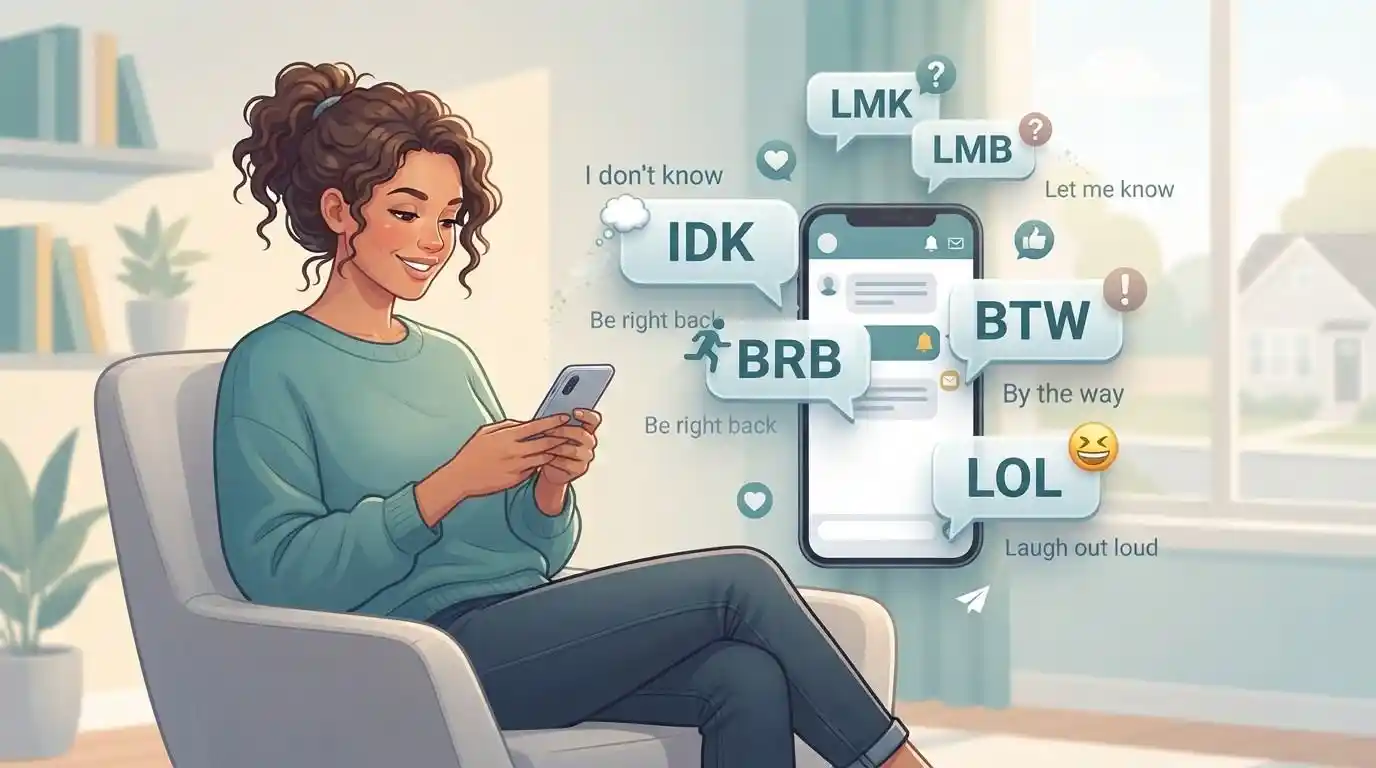
Basic conversation abbreviations are shortened forms of common words and phrases used in texts, DMs, group chats, comments, and other casual online conversations. Examples include IDK, BRB, BTW, LOL, and LMK.
Key Takeaways
- Basic conversation abbreviations make everyday digital messages shorter and quicker to type.
- Common examples include IDK, BRB, BTW, LOL, LMK, TTYL, IMO, TBH, and FYI.
- They can be used for questions, reactions, opinions, updates, and ending conversations.
- Most are informal, although some abbreviations such as ASAP and FYI can also appear in practical or workplace communication.
- Context matters because some abbreviations can have more than one meaning.
- Texting shorthand is generally better suited to casual communication than formal writing.
Basic Conversation Abbreviations Meaning in Text
Basic conversation abbreviations are a form of messaging shorthand that replaces longer words or phrases with shorter forms. They are commonly used in text messages, instant messaging, DMs, group chats, social media, and online conversations.
Some are formed from the first letters of a phrase, such as IDK for “I don’t know.” Others shorten individual words, such as “pls” for “please.”
These abbreviations can serve different purposes. They may help someone ask a question, give an update, express an opinion, react to something, or quickly end a conversation.
For example:
- IDK = I don’t know
- BRB = Be right back
- BTW = By the way
- LMK = Let me know
- TTYL = Talk to you later
- LOL = Laugh out loud
- TBH = To be honest
- IMO = In my opinion
Not every shortened form is technically an acronym. “Texting abbreviations,” “initialisms,” “shortened words,” and “internet slang” can overlap, so “basic conversation abbreviations” is best understood as a broad category.
What Do Basic Conversation Abbreviations Stand For?
There is no single full form for “basic conversation abbreviations” because it describes a category rather than one specific abbreviation.
Here are useful examples for everyday conversations:
| Abbreviation | Meaning | Common Use |
|---|---|---|
| ASAP | As soon as possible | Requests or timing |
| BRB | Be right back | Temporarily leaving |
| BTW | By the way | Adding another point |
| FYI | For your information | Sharing information |
| G2G / GTG | Got to go | Ending a conversation |
| HMU | Hit me up | Asking someone to contact you |
| IDK | I don’t know | Expressing uncertainty |
| IDC | I don’t care | Expressing indifference |
| IKR | I know, right? | Agreeing with someone |
| IMO | In my opinion | Giving an opinion |
| JK | Just kidding | Clarifying a joke |
| LMK | Let me know | Asking for a response |
| LOL | Laugh out loud | Showing amusement |
| NGL | Not gonna lie | Introducing an honest statement |
| NVM | Never mind | Dropping a topic |
| OMG | Oh my God / Oh my gosh | Surprise or excitement |
| OMW | On my way | Giving a travel update |
| RN | Right now | Referring to the present |
| SMH | Shaking my head | Disbelief or disappointment |
| TBH | To be honest | Giving a candid opinion |
| TMI | Too much information | Reacting to oversharing |
| TTYL | Talk to you later | Ending a conversation |
| WBU | What about you? | Returning a question |
| WYD | What are you doing? | Asking what someone is doing |
| WYA | Where you at? | Asking where someone is |
| YW | You’re welcome | Responding to thanks |
Some of these are initialisms, while others are abbreviations or texting shorthand. In everyday conversation, people often use these categories interchangeably.
How Are Basic Conversation Abbreviations Used?
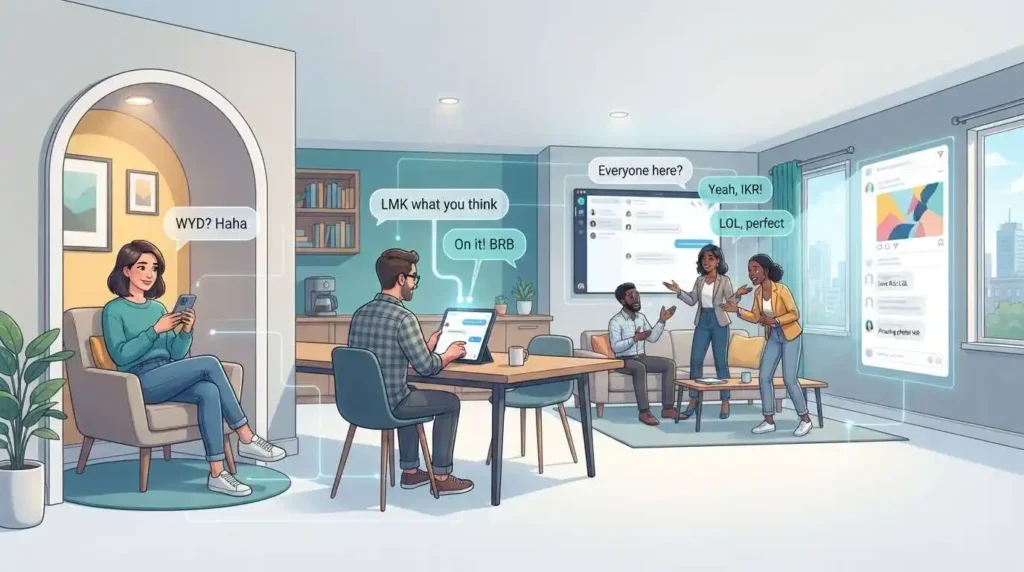
Basic conversation abbreviations have several practical uses in digital communication.
Text Messages
They can make everyday texts shorter and easier to type.
For example:
“WYD tonight?”
“IDK yet.”
The abbreviations keep the conversation quick and casual.
DMs
People often use abbreviations in direct messages when asking questions, making plans, or reacting to something.
Example:
“LMK when you’re free.”
Group Chats
Abbreviations can make fast-moving group conversations easier to follow.
Example:
“BRB, grabbing some food.”
Social Media Comments
Short forms such as LOL, OMG, TBH, and IKR can work as quick reactions.
Example:
“That ending was wild lol.”
Gaming
Some abbreviations are especially useful when people need to communicate quickly during a game.
For example:
“BRB”
or:
“GTG”
The exact terminology can vary depending on the gaming community and situation.
Basic Conversation Abbreviations in Different Contexts
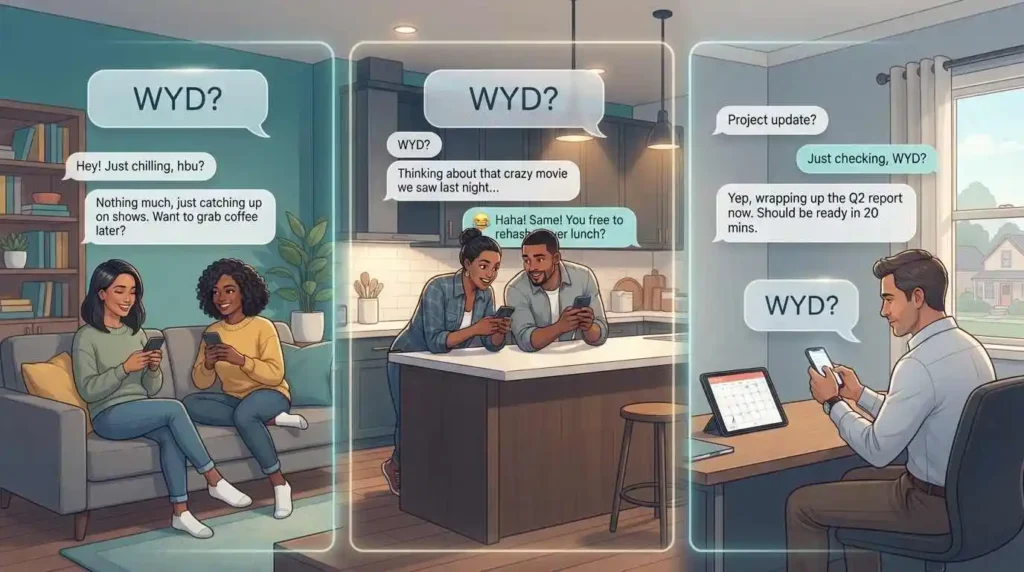
The meaning of an abbreviation usually stays the same, but the reason someone uses it can change.
From a Friend
A friend might use WYD simply to start a conversation or make plans.
Example:
“WYD later?”
That does not necessarily carry any deeper meaning.
From a Guy
Basic conversation abbreviations do not automatically have different meanings when a guy uses them.
For example, “WYD” still means “what are you doing?” The context may tell you why he is asking, but the abbreviation itself does not establish a particular intention.
From a Girl
The same applies when a girl uses an abbreviation. Gender does not change the standard definition.
From a Crush
An abbreviation such as WYD or HMU may appear in a conversation with a crush, but the abbreviation alone does not prove romantic interest.
For example:
“WYD?”
could simply mean:
“What are you doing?”
The rest of the conversation is needed to understand the person’s intent.
In Dating
People may use basic abbreviations while making plans or keeping a conversation casual.
Example:
“LMK if you’re free Saturday.”
Here, LMK is simply a convenient way to say “let me know.”
In a Relationship
Partners may use abbreviations in ordinary conversations:
“TTYL, I have to go.”
This simply indicates that the conversation is ending temporarily.
In a Group Chat
Short forms can help people respond quickly:
“WBU?”
This means “what about you?” and returns the same question to another person.
In Social Media Comments
An abbreviation such as “IKR” can show agreement:
“That movie was way too long.”
“IKR.”
The meaning is straightforward from the surrounding comment.
Real Chat Examples
- “IDK what time I’ll be home.”
- “BRB, someone is calling me.”
- “BTW, did you finish the assignment?”
- “LMK when you’re available.”
- “LOL that was hilarious.”
- “TBH, I liked the first one better.”
- “WYD right now?”
- “WBU?”
- “OMG, that’s confused.”
- “NVM, I found it.”
- “TTYL, I have to go.”
- “I’m OMW.”
- “FYI, the meeting starts at 3.”
- “JK, I was just messing with you.”
- “SMH, I can’t believe that happened.”
- “NGL, that was actually pretty good.”
- “HMU when you get home.”
- “G2G, talk later.”
- “ASAP would be great if possible.”
- “IDC which movie we watch.”
- “IKR? I thought the same thing.”
- “TMI 😂”
- “WYA? We’re waiting for you.”
- “RN I’m just relaxing.”
- “YW!”
How to Reply to Basic Conversation Abbreviations
Your reply depends on which abbreviation the other person used.
Casual Replies
For everyday abbreviations, a natural response is usually enough.
- “Same here.”
- “Got it.”
- “Okay.”
- “Sounds good.”
- “Sure.”
Friendly Replies
When chatting with friends, you can keep the response informal.
- “LOL, same.”
- “I know 😂”
- “Yep, I’ll let you know.”
- “Sounds good!”
- “Talk later.”
Funny Replies
For playful conversations:
- “You and your abbreviations 😂”
- “Translation please.”
- “I need a texting dictionary.”
- “Okay, I understood that one.”
- “You’re making me work for this conversation.”
Neutral Replies
If you are unsure what an abbreviation means:
- “What does that mean?”
- “What does that stand for?”
- “Can you clarify?”
- “I’m not familiar with that abbreviation.”
- “Do you mean ___?”
Flirty/Relationship Replies
Some basic abbreviations can appear in conversations between people who like each other, but the abbreviation itself does not establish romantic intent.
For example, if someone sends:
“WYD?”
You might simply reply:
“Just hanging out. You?”
If the conversation is already clearly playful, you can respond naturally without assuming the abbreviation has a hidden romantic meaning.
What Tone Do Basic Conversation Abbreviations Have?
The tone depends on the specific abbreviation and the surrounding message.
Casual
IDK, BTW, RN, and TTYL are generally informal and conversational.
Friendly
WBU, LMK, and HMU can sound natural in friendly conversations.
Playful
LOL, JK, and OMG can help communicate amusement, surprise, or joking.
Direct
ASAP, GTG, and IDC can sound more direct because they communicate a specific request, decision, or attitude.
Opinion-Based
IMO, TBH, and NGL often introduce personal opinions or candid reactions.
Context-Dependent
Some short replies can feel warmer, colder, or more dismissive depending on the conversation.
For example:
“IDC 😂”
may sound playful between friends, while:
“IDC.”
could feel more blunt in a disagreement.
Is Basic Conversation Abbreviations Rude or Offensive?
Basic conversation abbreviations are not inherently rude or offensive.
They are generally suitable for casual texts, DMs, group chats, and informal social media conversations.
However, some abbreviations can sound blunt depending on the message. For example, “IDC” literally communicates indifference, so a one-word reply of “IDC” may feel dismissive.
In school assignments, formal emails, applications, and other professional writing, it is usually better to use complete words unless the abbreviation is accepted in that setting.
Some abbreviations, such as ASAP and FYI, can appear in professional communication because they are also used outside casual texting.
Other Meanings of Basic Conversation Abbreviations
Because this is a broad category rather than one specific abbreviation, individual terms can have other meanings in different contexts.
Basic Conversation Abbreviations in Technology
Some abbreviations are strongly associated with digital communication.
For example:
- DM = direct message
- AFK = away from keyboard
- FAQ = frequently asked questions
These may be familiar outside casual texting as well.
Basic Conversation Abbreviations in Business
Several abbreviations used in conversations can also appear in workplace communication.
Examples include:
- ASAP = as soon as possible
- FYI = for your information
- ETA = estimated time of arrival
- EOD = end of day
These are not exclusively texting slang.
Basic Conversation Abbreviations With Multiple Meanings
Some abbreviations need context.
For example, “ATM” can mean “at the moment” in texting, while ATM also commonly refers to an automated teller machine.
Likewise, “IG” can mean “I guess” in some messages or refer to Instagram in other contexts.
The sentence and topic usually make the intended meaning clearer.
Common Mistakes About Basic Conversation Abbreviations
Assuming Every Abbreviation Is Slang
Not every abbreviation is slang. Some are simply shortened forms used for convenience, including ASAP, FYI, ETA, and FAQ.
Assuming Every Abbreviation Has One Meaning
Some abbreviations are context-dependent. ATM is a good example because its meaning can change completely depending on the conversation.
Assuming an Abbreviation Proves Romantic Interest
WYD, HMU, or similar abbreviations can appear in romantic conversations, but the letters themselves do not prove attraction or flirting.
Using Every Abbreviation in Formal Writing
Heavy texting shorthand can make a message difficult to understand in formal settings. Complete words are usually safer for school and professional communication.
Confusing Similar Abbreviations
IDK means “I don’t know,” while IMO means “in my opinion.” Both are common, but they serve different purposes.
Assuming Capitalization Always Changes Meaning
Many texting abbreviations can appear in uppercase or lowercase. Capitalization may affect the visual tone of a message, but it does not automatically create a different definition.
Basic Conversation Abbreviations and Related Slang
| Term | Meaning | Common Use |
|---|---|---|
| IDK | I don’t know | Uncertainty |
| LOL | Laugh out loud | Amusement |
| BRB | Be right back | Temporary absence |
| BTW | By the way | Adding a point |
| TBH | To be honest | Candid statement |
| NGL | Not gonna lie | Honest reaction |
| LMK | Let me know | Requesting an update |
| TTYL | Talk to you later | Ending a chat |
| WYD | What are you doing? | Casual question |
| WBU | What about you? | Returning a question |
| SMH | Shaking my head | Disbelief or disappointment |
| NVM | Never mind | Dropping a topic |
| OMW | On my way | Giving a status update |
| HMU | Hit me up | Asking someone to contact you |
| FYI | For your information | Sharing information |
These terms cover different parts of everyday conversation, including questions, reactions, opinions, updates, and conversation endings.
People Also Ask About Basic Conversation Abbreviations
What are the most common basic texting abbreviations?
Common examples include IDK, LOL, BRB, BTW, LMK, TTYL, TBH, IMO, FYI, and OMG. Their exact usefulness depends on the type of conversation and the people involved.
What does IDK mean in texting?
IDK means “I don’t know.” It is used when someone does not know the answer, is uncertain, or does not have an opinion.
What does BRB mean in a conversation?
BRB means “be right back.” It tells the other person that the sender is temporarily leaving the conversation and expects to return.
What does LMK mean in texting?
LMK means “let me know.” It is commonly used when asking someone to provide an update, answer, or decision later.
What does TTYL mean?
TTYL means “talk to you later.” It is generally used when someone is ending a conversation temporarily but expects to communicate again.
Are texting abbreviations still used?
Yes, texting abbreviations remain part of digital communication, although the specific terms people use can vary by context, community, and personal preference. Not every abbreviation is equally familiar to every reader.
Are texting abbreviations appropriate for work?
Some are. Abbreviations such as ASAP, FYI, ETA, and FAQ can appear in professional communication, while highly casual terms such as LOL or WYD are usually better suited to informal conversations.
Why do people use abbreviations in conversations?
Abbreviations can make messages shorter and faster to type. They can also provide convenient shorthand for common reactions, questions, opinions, and updates.
Conclusion
Basic conversation abbreviations are shortened forms used to make everyday texts, chats, DMs, group messages, and social media conversations more concise.
Common examples include IDK, BRB, BTW, LOL, LMK, TTYL, TBH, IMO, FYI, and WYD. They can communicate uncertainty, amusement, opinions, questions, updates, or the end of a conversation.
Most are informal, although some, such as ASAP and FYI, are also used in professional settings. Context is especially important because some abbreviations can have different meanings.
When you encounter an unfamiliar abbreviation, consider the surrounding message and conversation before interpreting it. If the meaning is still unclear, simply ask what it stands for.

Christopher Hayes has spent five years writing puns and jokes built around the language of specific subjects. His work spans animals, seasonal themes, technology, entertainment, trending topics, and food-related wordplay. He examines terminology and possible word connections, builds joke premises from them, and fine-tunes setups and punchlines for precision, rhythm, and comedic effect.